Behind the Image
What eventually brought me into cinema and the world of visual effects was, strangely enough, a growing fascination with how easily our perception of reality can be manipulated.
One of the first things that truly struck me was an intervention by the Czech art collective Ztohoven. On June 17, 2007, they interrupted a live broadcast of Czech Television’s Panorama and inserted footage of a simulated nuclear explosion into an otherwise peaceful view of the Krkonoše mountains. Their project was called Media Reality.
I was fascinated. It made me realize that almost any visual information we receive can be altered – and that what we see with our own eyes is not necessarily what actually happened.
Another revelation was Jan Kounen’s 99 Francs (2007), starring Jean Dujardin and based on the novel by Frédéric Beigbeder. The film opened my eyes to the mechanisms of advertising and to how images, brands and carefully constructed desires can influence the way we think and behave. Social media had not yet become what it is today, but this is one of the reasons why I later chose to stay away from Facebook and Instagram. Today, the mechanisms of persuasion have become infinitely more sophisticated.
In 2012 came across a video supposedly documenting election fraud in Russia. It had been shot against a green screen on purpose. What interested me was not which political side benefited from it. The realization was much broader: visual manipulation belongs to no single ideology. Opposition movements, governments, corporations, media organizations – anyone with the necessary tools can construct an image of reality and present it as truth. And we are talking about something far beyond editing or the Kuleshov effect.
Years later, working at various VFX studios, I saw just how far these possibilities could go: scanning and digitally replicating real locations, transforming environments, and creating detailed 3D doubles of real actors. The line between capturing reality and constructing it was already becoming increasingly difficult to see.
And now we have entered the age of AI.
Today, even some of my colleagues who have spent years working professionally with images can no longer reliably distinguish a photograph or video from something generated entirely by a machine. That makes understanding how images are created more important than ever.
This was one of the reasons I consciously wanted to work in visual effects – and why I remain deeply interested in artificial intelligence today. At a time when the information presented to us exists at the intersection of advertisers competing for our attention, powerful media corporations and politicians fighting for influence, understanding the machinery behind images gives us at least a chance to understand the digital world we are entering.
We are moving rapidly into an environment we have never experienced before. Finding the truth is becoming harder, because increasingly even the evidence of our own eyes is no longer enough. Recognizing this is becoming a fundamental form of media literacy – and it will only become more difficult.
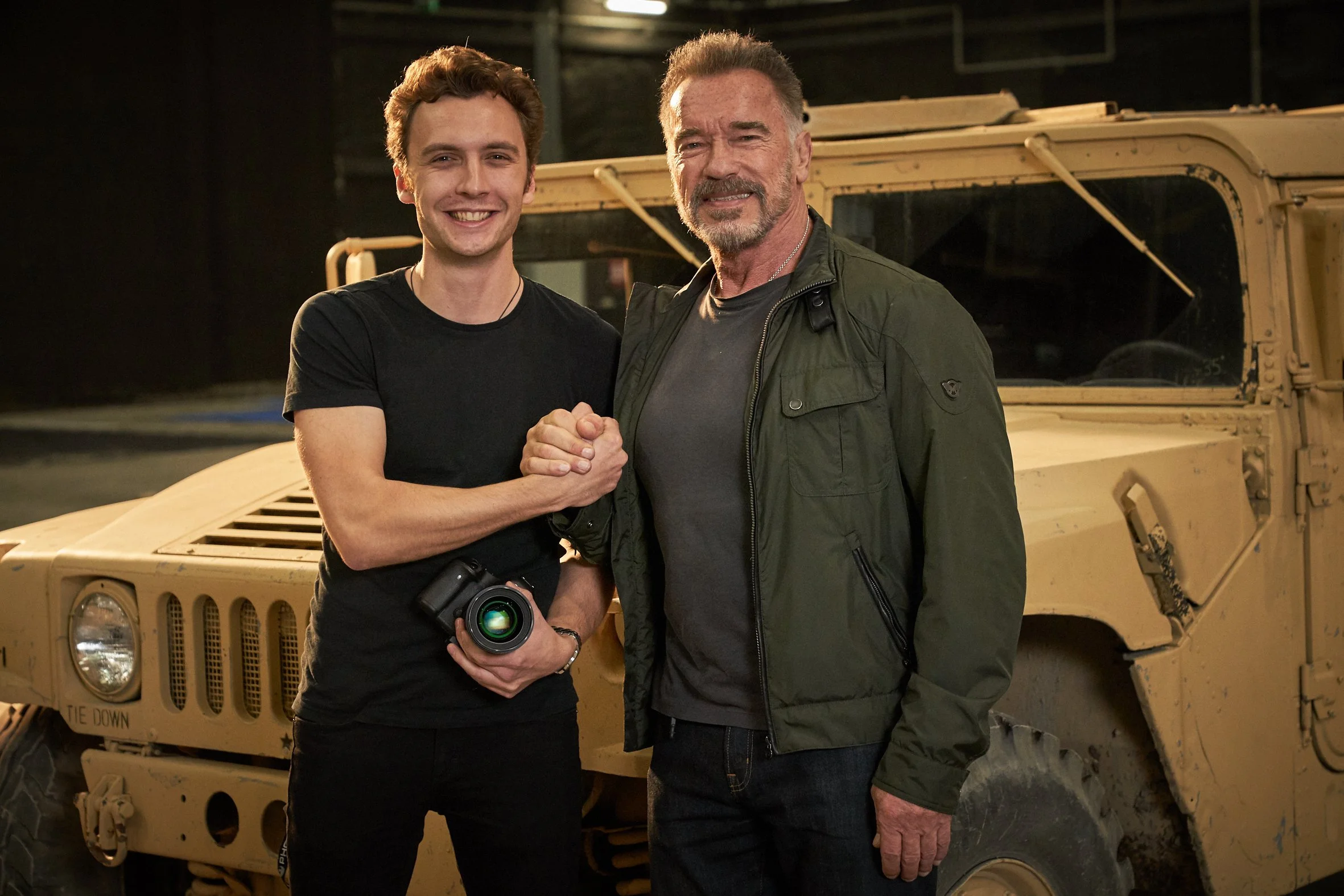
By the way, the photograph of me with Arnold Schwarzenegger dates back to 2018, after working on Terminator: Dark Fate (2019). Is the photograph real? That is for you to decide. Today, I could probably show you an image like this and never be able to convince you one way or the other. And I can’t share much more from other projects either thanks to those lovely NDAs. But you can find my name in the credits. 😛
Stay curious. Stay critical. And never let an image convince you simply because it looks real.